Tuesday, 19 May 2020

EAST AFRICA RISING GROUP PARTNERS DEVELOPMENT DISPATCH PODCAST FOR #SILENCINGTHEGUNS TWEET-CHAT (#ECOWAS VS #EAC)


EAST AFRICA RISING GROUP PARTNERS DEVELOPMENT DISPATCH PODCAST FOR #SILENCINGTHEGUNS TWEET-CHAT (ECOWAS VS EAC)

A Public Conversation titled: 

RECs, Peace & Security- Lessons from West to East Africa

At the AU 50th Anniversary on 25 May 2013, the Heads of State and Government "pledged not to bequeath the burden of conflicts to the next generation of Africans and undertake to end all wars in Africa by 2020". The AU theme for 2020 is "Silencing the guns: Creating conducive conditions for Africa's development". The premise of this theme is that socio-economic development is at risk without peace and security and both issues should be prioritised.

In commemoration of this year's Africa Day on 25 May, East Africa Rising Group and DevDispatch are organising a public conversation via Twitter that will bring together voices from East and West Africa to discuss and share experiences on the role of RECs in addressing the challenges of conflict, governance and insecurity on the continent and the lessons from ECOWAS for East Africa.

The Twitter chat will take place at 9am – 10am GMT on the hashtag #lessonsfromW2EAfrica. Addirional hashtags for the chat include #Africapeaceandsecurity #silencingtheguns

Background:

Both ECOWAS, EAC and IGAD were established as regional economic blocs to facilitate economic growth, integration, co-operation and development among its members. Overtime, the dream of trade and development integration has been hampered by violent conflicts and instability on the continent. Consequently, RECs in recognition of the linkage between regional security and regional economic development and the pivotal role they can play in implementing the African Union's (AU's) Peace and Security Architecture (APSA), have expanded their portfolio to include peace, stability and regional security.

However, the extent of intervention by ECOWAS in West Africa and EAC and IGAD in East Africa have been vastly different. Political instability and conflict in countries like Cote d'Ivoire, Guinea Bissau, Liberia, Mali, Nigeria, Sierra Leone and The Gambia has seen ECOWAS rise to the occasion providing military support, early warning systems, security sector reform and other post-conflict reconstruction and rehabilitation efforts. EAC and IGAD have done the same in their member states but to a lesser extent despite the reoccurring and protracted conflicts and terrorism in the region- think Sudan, Kenya, Eritrea, Burundi and 


Somalia. The importance of collective security in East Africa to consolidate the growing economic gains cannot be emphasised and this presents a huge opportunity for EAC and IGAD to step up.

In commemoration of the 2020 Africa Day under the theme " Silencing the gun", we would like to center the conversation on the role of RECs in managing conflict on the continent, the role that they should play and lessons that the RECs in the East African region can learn from ECOWAS with regards to its response to conflict, political instability and governance in West Africa.

Format

The chat will be moderated by DevDispatch and panellist will include experts in issues of peace, security, conflict management and governance on the continent. Suggested panellists include:

  1. Michelle Ndiaye- Director Africa Peace & Security Programme (APSP) / Head of Secretariat, Tana Forum

  2. Nnamdi Obasi- Senior Adviser, Crisis Group

  3. Emmanue K. Bensah- Communicator on all things peace and security in Africa and advocate at East Africa Rising.

  4. Yvonne Akpasom- Head, Peace and Security Unit, GIZ ECOWAS Support Programme

  5. Charles Nyuykonge- Senior Researcher at the African Centre for the Constructive Resolution of Disputes, Political analyst, and Peace and security practitioner

  6. Tigist Hailu- PR and Communications Officer, IGAD's Conflict Early Warning and Response Mechanism (CEWARN)

  7. Chukwuemeka B. Eze- Executive Director of West Africa Network for Peacebuilding (WANEP)

  8. Roba D Sharamo- Regional Representative for the AU, and Horn and East Africa. Institute for Security Studies (ISS)

  9. Simon Nyambura- Director, IGAD Center of Excellence for Preventing and Countering Violent Extremism (ICEPCVE)


**** Panellist in red are yet to confirm.


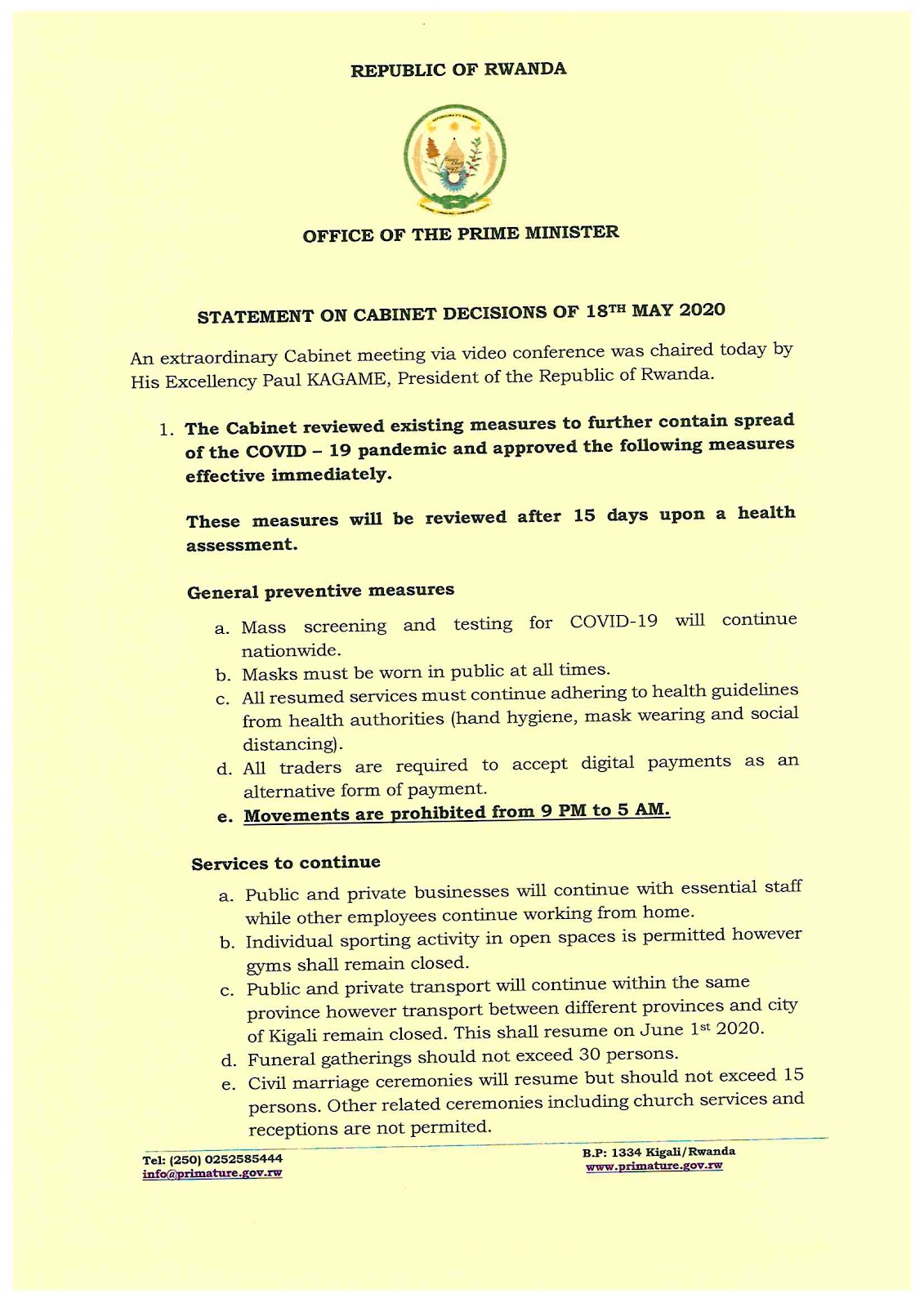
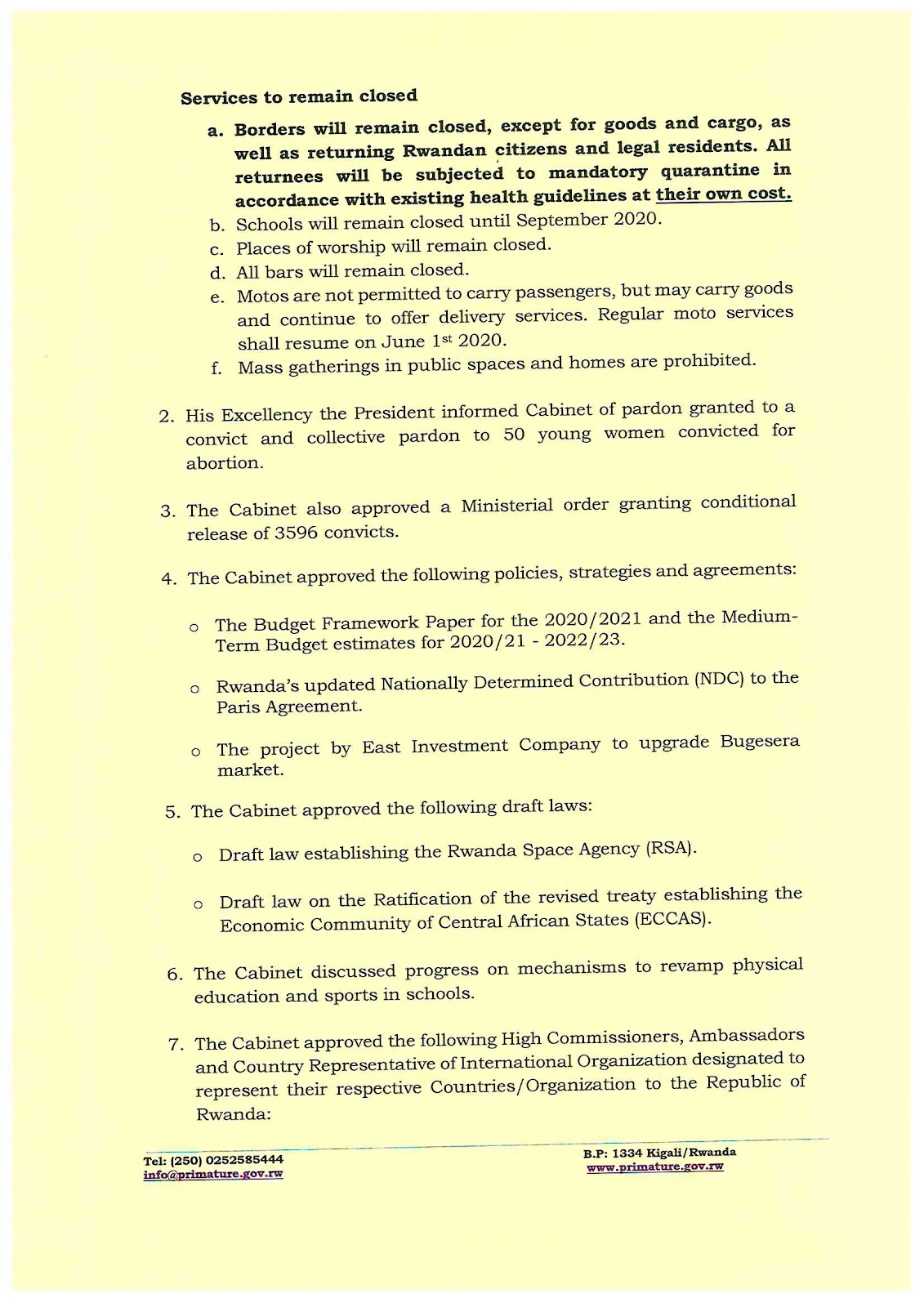
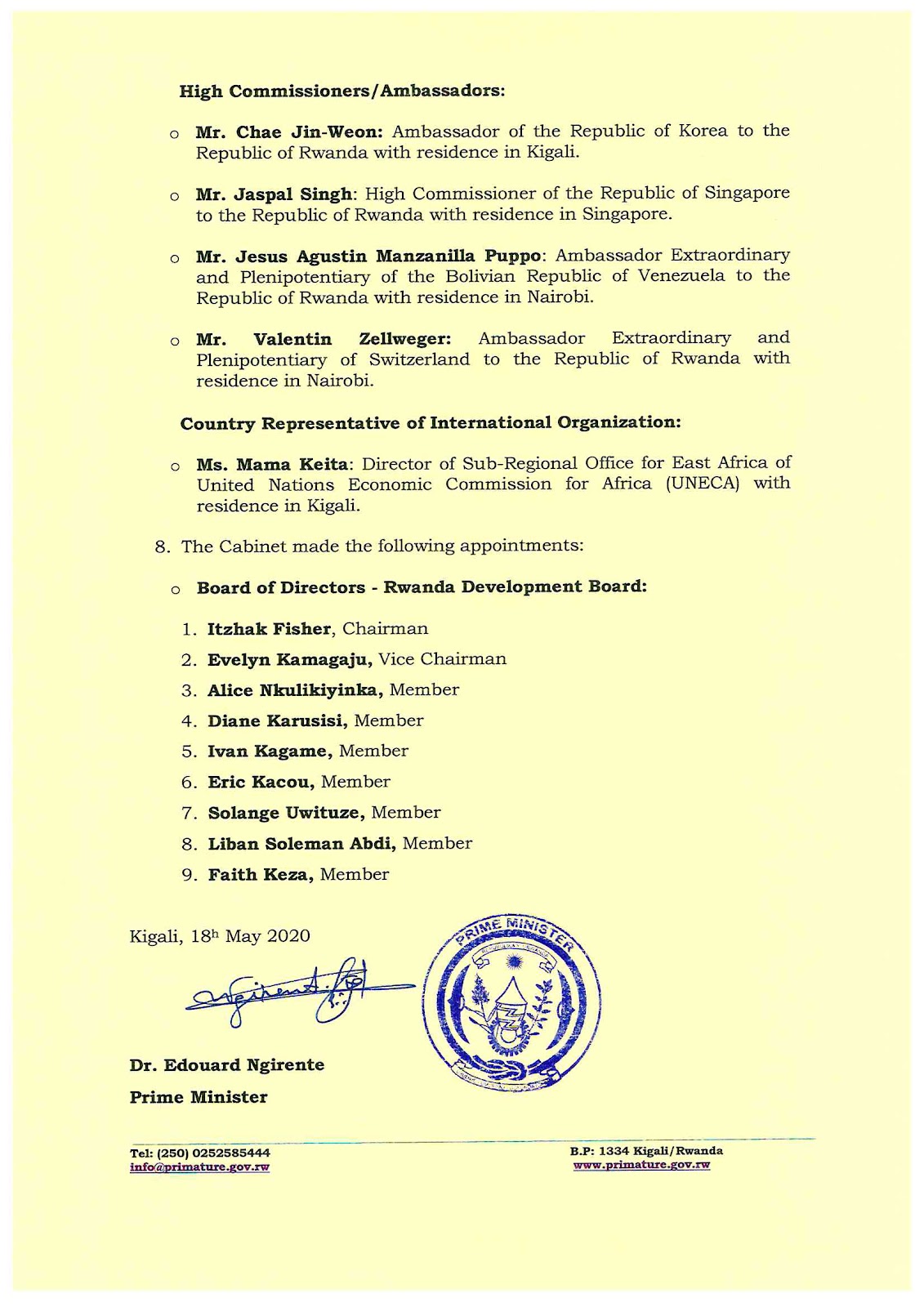
Statement on (Rwanda) Cabinet Resolutions of 18/05/2020 https://t.co/KjBOREvPF5


Decisions taken by government of Rwanda, including the establishment of a Rwandan Space Agency, and the decision to open schools from September 2020 in light of COVID19. 


Monday, 18 May 2020

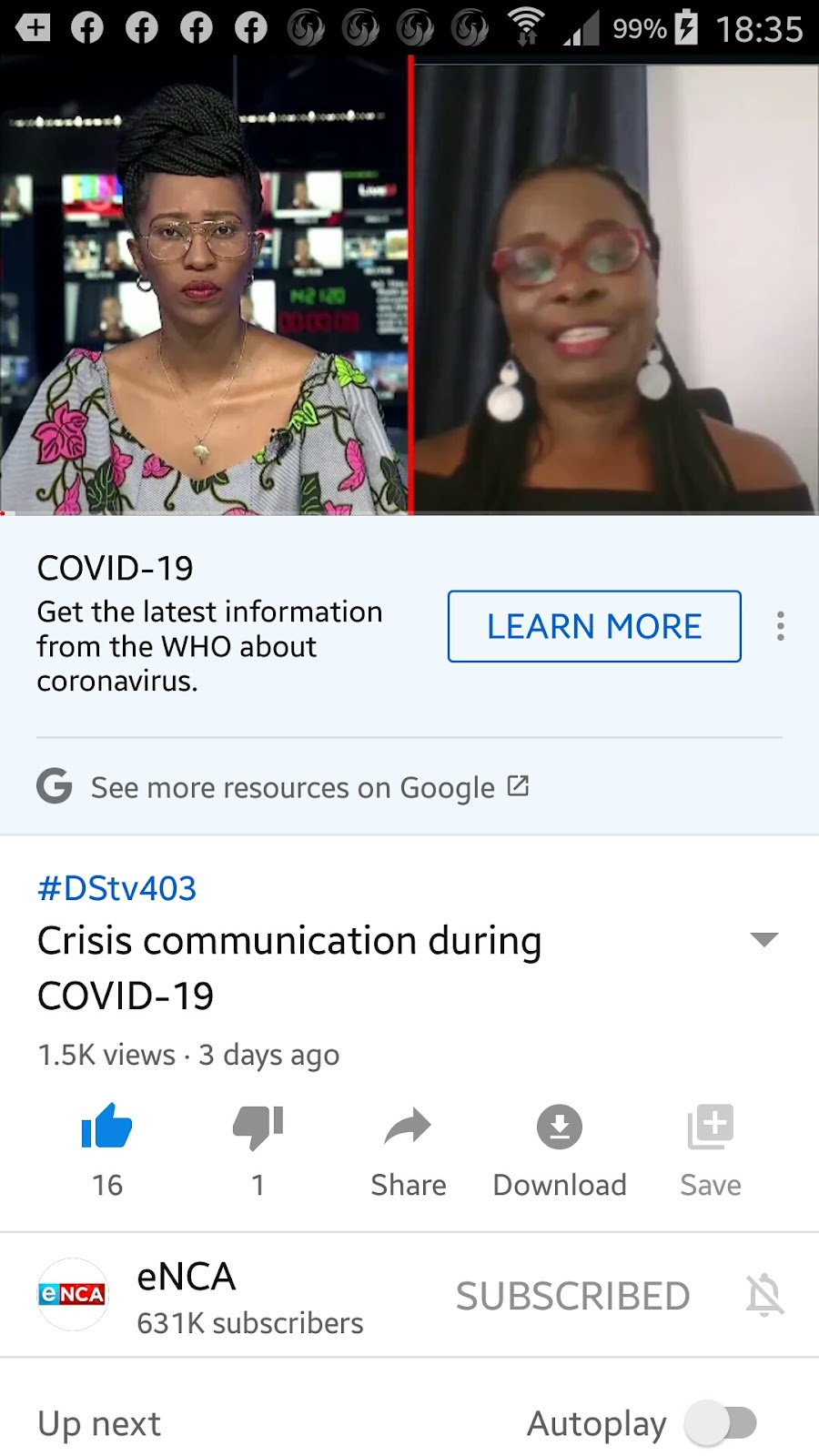
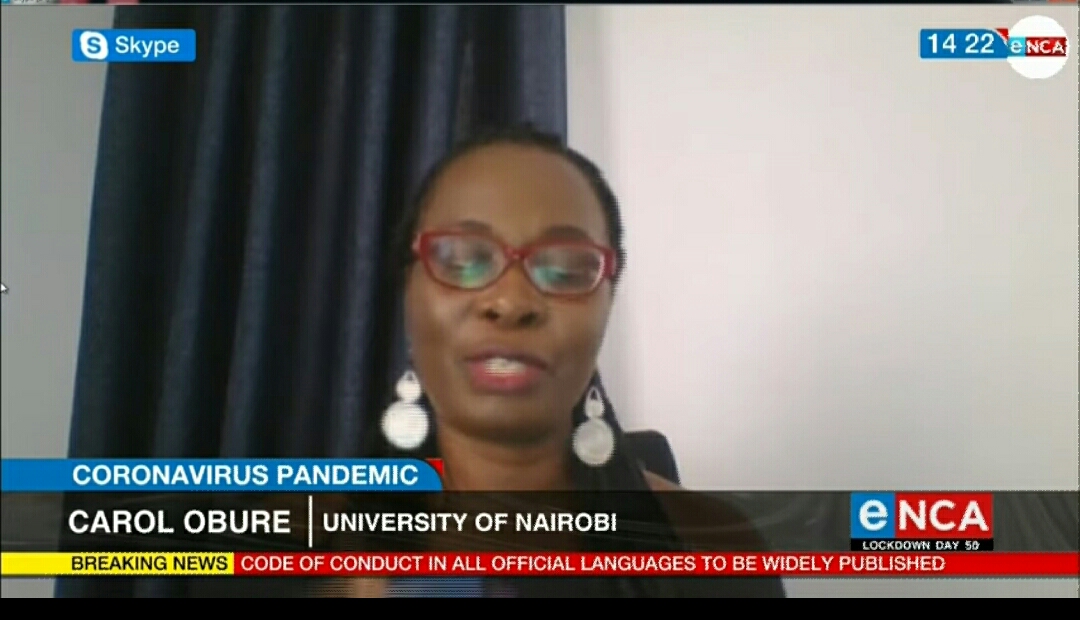
#INTERVIEW: Crisis Communication During COVID19 -- an Interview with Carole Obure, University of Nairobi


eNCA TV Interview 

 1. What is the role of communicators?

The role of communicators goes beyond communicating. Their roles include story-telling; turning complex arguments and ideas into simple and digestible ones. In a crisis like this, communicators are the unacknowledged front liners – in the sense that they effectively unpack information from the technical team- Researchers/ Epidemiologists / Doctors and other cadres of medical specialists into practicable, edible and digestible information for the consumption of the public. They need to advance views that are not their own in ways that are objective and touch the core of the issue.


2. What has been your assessment on how governments on the continent have communicated about the pandemic?

Governments have largely performed well in handling Communication around the pandemic. While everyone was caught flat-footed, those that have performed better have trodden the fine line between rule of law, human rights and freedoms. 

Freedoms remain critical in this conversation given how governments have been compelled to virtually shut down economies and mete out draconian rules and regulations onto the population (physical distancing protocols; ban on social gathering; enforcement of face-masks; closure of borders,etc) so as to save them from the virus. 

Ordinarily, some of these measures would have been those adopted by authoritarian government's intent on curbing freedoms. The pandemic has not just created a new normal but upturned normality and stretched it to its limit where ordinary citizens are even calling for enforcement of draconian measures just to save ourselves.

However, it's time to change the Narrative without distorting the message. It`s time to shift the Covid 19 communication strategy from FEAR of Corona virus to Understanding the disease.

There are certain realities about Covid 19 that will have to be accepted eg.

WHO Emergencies Director Michael Ryan says COVID-19 may become an endemic virus; (Coronavirus may never go away) therefore there is need to come to terms with it.

  • 99% of the people infected with the Corona virus are asymptomatic or have mild symptoms. Many will never know they had it.

  • By concentrating on the sick or the dead, we are concentrating on the thinnest layers of the epidemic which is the reason I said we need to shift the communication strategy without distorting the message.

  • The risk of death is 0.1% 

  • Whatever measures taken, people will get infected, and those vulnerable will die, so best to take actions to protect the vulnerable.

By changing the communication strategy, we will be eradicating fear and planting understanding in the general public .A look at the statistics reveals that there will definitely be a switch to new normal  and the process has to start now .We just can't totally freeze the economy with extended durations of strict Coronavirus restrictions e.g. lockdowns. If we did that, we will be doing more harm to individuals, families and communities than Corona could ever do. 

We also can't proceed with life as was usual and ignore all precautions; the price to pay would be too high. So we need a middle ground. For the debate to move to acceptance of this middle ground, the public needs to UNDERSTAND Corona more than they FEAR it. Fear does not stop death, it stops life.


3. This is obviously a fluid and uncertain circumstance, what are the basics of crisis communication and would this crisis be any different?


There are levels of crises. A pandemic is a different kind of crisis that calls for sober heads to do more introspection and reflection on messaging.

Crisis communication operates from assumption that an emergency compels one to draw up a plan to deal with that emergency in a manner that is.as quick and short-term as possible.

What COVID19 has shown is that crisis communication needs to be beefed up considerably so that there is a level of uniformity of messaging in the long-term. The emergence of fake news has challenged the work of crisis communicators who need to be regularly verifying the messaging on what can be done to keep one safe from the virus.


4. You turn on any medium, you're likely to hear the words anxiety inducing, uncertain times etc. What roles do us as journalists in this communication ecosystem in quelling negativity?

 Quelling negativity is an interesting and important turn of the phrase. As Frontlines in the war against fake news on how to fight the virus, journalists have a responsibility to use messaging that assuages calms and assures populations that it is possible to beat this pandemic by observing protocols governments have put out for citizens to follow.

 Quelling negativity includes journalists using messaging that is specific to the pandemic and not extraneous to it .It is so important journalists are clear, concise and consistent in their messaging as practicably as possible.

Finally, look for opportunity and positivity -If there are positive things you can share to inspire hope, play your part in lifting the mood and reassure others.


ENDs

Friday, 24 April 2020

ARTICLE: "WILL HYDROCARBON RICH AFRICAN COUNTRIES BE LEFT GASPING FOR BREATH IN THE AFTERMATH OF THE CORONAVIRUS?"

*WILL HYDROCARBON RICH AFRICAN  COUNTRIES BE LEFT GASPING FOR BREATH IN THE AFTERMATH OF THE  CORONAVIRUS?* _Towards new imperatives for natural resource diversification_.
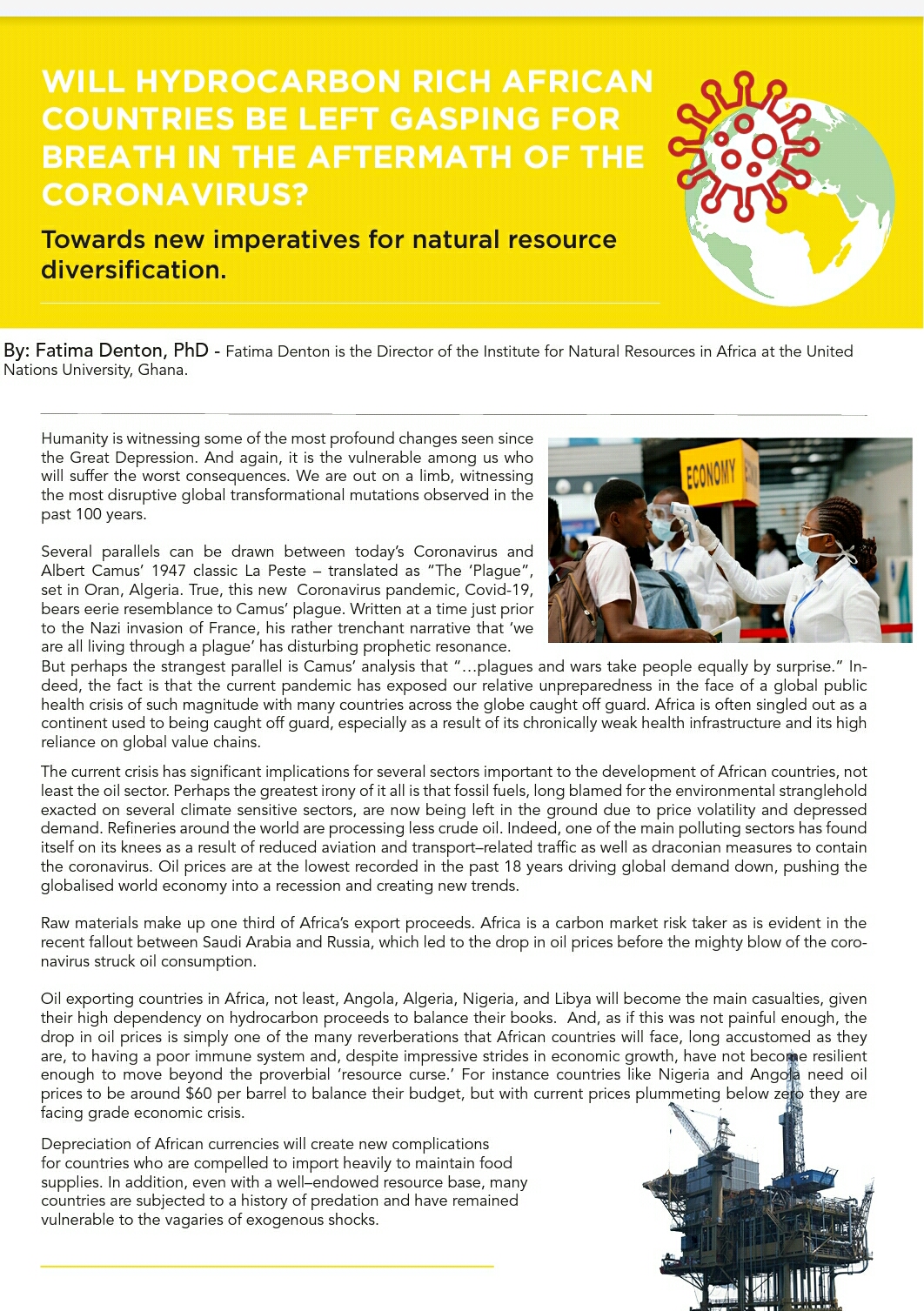


*By*: *Fatima Denton, PhD* - _Fatima Denton is the Director of the Institute for Natural Resources in Africa at the United Nations University, Ghana_.


Humanity  is witnessing  some of the most  profound changes seen  since the Great Depression.  And again, it is the vulnerable  among us who will suffer the worst  consequences. We are out on a limb,  witnessing the most disruptive global transformational  mutations observed in the past 100 years. 


Several  parallels  can be drawn  between today's  Coronavirus and Albert  Camus' 1947 classic La Peste  – translated as "The 'Plague", set  in Oran, Algeria. True, this new Coronavirus  pandemic, Covid-19, bears eerie resemblance to Camus'  plague. Written at a time just prior to the Nazi invasion  of France, his rather trenchant narrative that 'we are all living through a plague' has disturbing prophetic resonance. But  perhaps the strangest parallel is Camus' analysis that "…plagues and wars take people equally by surprise." Indeed, the  fact is that the current pandemic has exposed our relative unpreparedness in the face of a global public health crisis of  such magnitude with many countries across the globe caught off guard. Africa is often singled out as a continent used to being  caught off guard, especially as a result of its chronically weak health infrastructure and its high reliance on global value chains. 


The  current  crisis has  significant implications  for several sectors important  to the development of African countries,  not least the oil sector. Perhaps the greatest  irony of it all is that fossil fuels, long blamed  for the environmental stranglehold exacted on several climate  sensitive sectors, are now being left in the ground due to price  volatility and depressed demand. Refineries around the world are processing  less crude oil. Indeed, one of the main polluting sectors has found itself  on its knees as a result of reduced aviation and transport–related traffic as  well as draconian measures to contain the coronavirus. Oil prices are at the lowest  recorded in the past 18 years driving global demand down, pushing the globalised world economy into a recession and creating new trends. 


Raw  materials  make up one  third of Africa's  export proceeds. Africa  is a carbon market risk  taker as is evident in the recent  fallout between Saudi Arabia and Russia,  which led to the drop in oil prices before  the mighty blow of the coronavirus struck oil consumption. 


Oil  exporting  countries in  Africa, not least,  Angola, Algeria, Nigeria,  and Libya will become the  main casualties, given their high  dependency on hydrocarbon proceeds to  balance their books. And, as if this  was not painful enough, the drop in oil prices  is simply one of the many reverberations that African  countries will face, long accustomed as they are, to having  a poor immune system and, despite impressive strides in economic  growth, have not become resilient enough to move beyond the proverbial  'resource curse.' For instance countries like Nigeria and Angola need oil prices  to be around $60 per barrel to balance their budget, but with current prices plummeting  below zero they are facing grade economic crisis.


Depreciation of African currencies will create new complications   for countries who are compelled to import heavily to maintain food   supplies. In addition, even with a well–endowed resource base, many countries are subjected to a history of predation and have remained   vulnerable to the vagaries of exogenous shocks.


Even  the most  optimistic forecasts  convey a world economy  in distress with global economic  growth being halved to 1.5 per cent  (OECD figures) almost certainly triggering  a world-wide recession. The UN Economic Commission  for Africa (UNECA) predicts that annual growth will  drop to 1.8% from a previous estimate of 3.2%. Oil dependent  countries such as Angola and Nigeria could lose up to $65 billion  in oil related incomes as a result of falling oil prices exacerbated by  the current COVID 19 pandemic. The drop in oil demand combined with the crash  in oil prices are already affecting exports. As of March 4, about 70 percent of  the April-loading cargoes of crude oil from Angola and Nigeria were still unsold. 


Quick  or short  recovery, resuscitating  the world economy will require  strong leadership and a keen eye  kept on macro-economic fundamentals.  Trade forecasts for other hydrocarbon  sensitive economies such as Gabon, Equatorial Guinea,  Algeria and Chad, to name but a few, will be bleak.    Mature oil established economies such as Nigeria and Angola  rely on oil revenues for close to 70% of their national budgets.  This absolute dependence on natural resources means that many countries  are at the mercy of the world economy and dwindling commodity prices –  their economic rents are predicated on prevailing trends of commodity goods  and when public health crises of pandemic scale strike, this reduces foreign  exchanges reserves, compromises social spending and derails hard won sustainable  development achievements. 


Africa  faces a  triple challenge  of transition towards  energy security, moving  towards a low carbon emissions  pathway and charting a growth and  transformation plan that will have to  lift millions out of poverty. The coronavirus  has made more apparent the vulnerabilities of highly  dependent economies on hydrocarbon resources and the associated  carbon exposure risks. The  


United  Nations University's  Institute for Natural  Resources in Africa (UNU-INRA)  research on stranded hydrocarbon assets,  intended as an alert to mineral rich countries,  discusses in a widely circulated paper the strong  likelihoods of asset 'stranding'. Stranded assets are  "assets that become devalued before the end of their  economic lifetime or can no longer be monetised due to  changes in policy and regulatory frameworks, markets forces,  societal or environmental conditions, disruptive innovation or security  issues". This paper was intended as a primer to send a message to African leaders,  especially in oil and gas rich countries, that if global economies move to a carbon  neutral world where fossil fuels became the principal enemy, then Africa will need to look  to new economic activities and markets. It signalled that with a growing number of companies  and shareholders divesting away from fossil fuels, Africa may have to manage its exit from the  sector to avoid potential jolts that economies might succumb to if severed from the main resource artery  and deprived of fossil fuel proceeds. The study showed that even in some emerging oil and gas countries,  the proceeds of oil and gas are being strategically employed towards important safety nets such as Ghana's free  senior high school policy. Today, given plummeting oil prices, there is little wonder that many African economies will  be left severely wounded. 


It  is becoming  increasingly urgent  for African governments  to diversify their economies  and create other forms of growth  poles beyond their natural resources.  This pandemic, as unwelcome and untimely  as it is, sends strong signals to Africa to  move rapidly towards promoting diversified economies  given the vulnerability of the fossil fuel market, and  the length of time it will take for Africa's oil exporting  countries to nurse themselves back to full recovery. Climate change  may not be the top priority of African governments in the post-Coronavirus  world, however, economy and ecology are two faces of the same development coin.  Hydrocarbon resources are metaphors for greater resource planning and an effective strategy  for African economies to enable a transition that results in a new model of growth. Indeed, Africa's  energy deficit makes the energy sector an essential muscle in its growth and transformation plan, but at  the same time, it says to African leaders that business as usual post-pandemic is tantamount to re-enforcing  widespread economic hardship. Recovery from this industrial scale depression must recognise the vulnerability of Africa's  resource base and the need to 'stockpile' on new diversified economic alternatives in order to reboot the economy. 


There  are new  predictions  that the current  pandemic will derail  achievement of almost all  of the sustainable development  goals. In Africa, where leaders  are struggling to square the sustainable  development circle and to manage onerous debt  repayments, new health vulnerabilities in known  hotspots will leave many economies gasping for breath. 


With  global  economies  heading towards  a cliff edge, Dr.  Rieux's famous "common  decency" retort in Camus'  Plague will go a long way to  ensuring that African economies are  not given a wide berth or left to go  on an indefinite social distance tour. Rather,  the post-corona era should start with critically  revisiting old paradigms and taking bolder moves towards  diversification of natural resources. But, for a continent  that has not had its share of the carbon budget, and not exercised  its full sovereignty vis a vis energy choices, adopting new perspectives  on energy futures can be considered as enlightened self-interest. As the Ethiopian  Prime Minister advises: "… if the virus is not defeated in Africa, it will only bounce back to the rest of the world."


ENDs

Wednesday, 22 April 2020

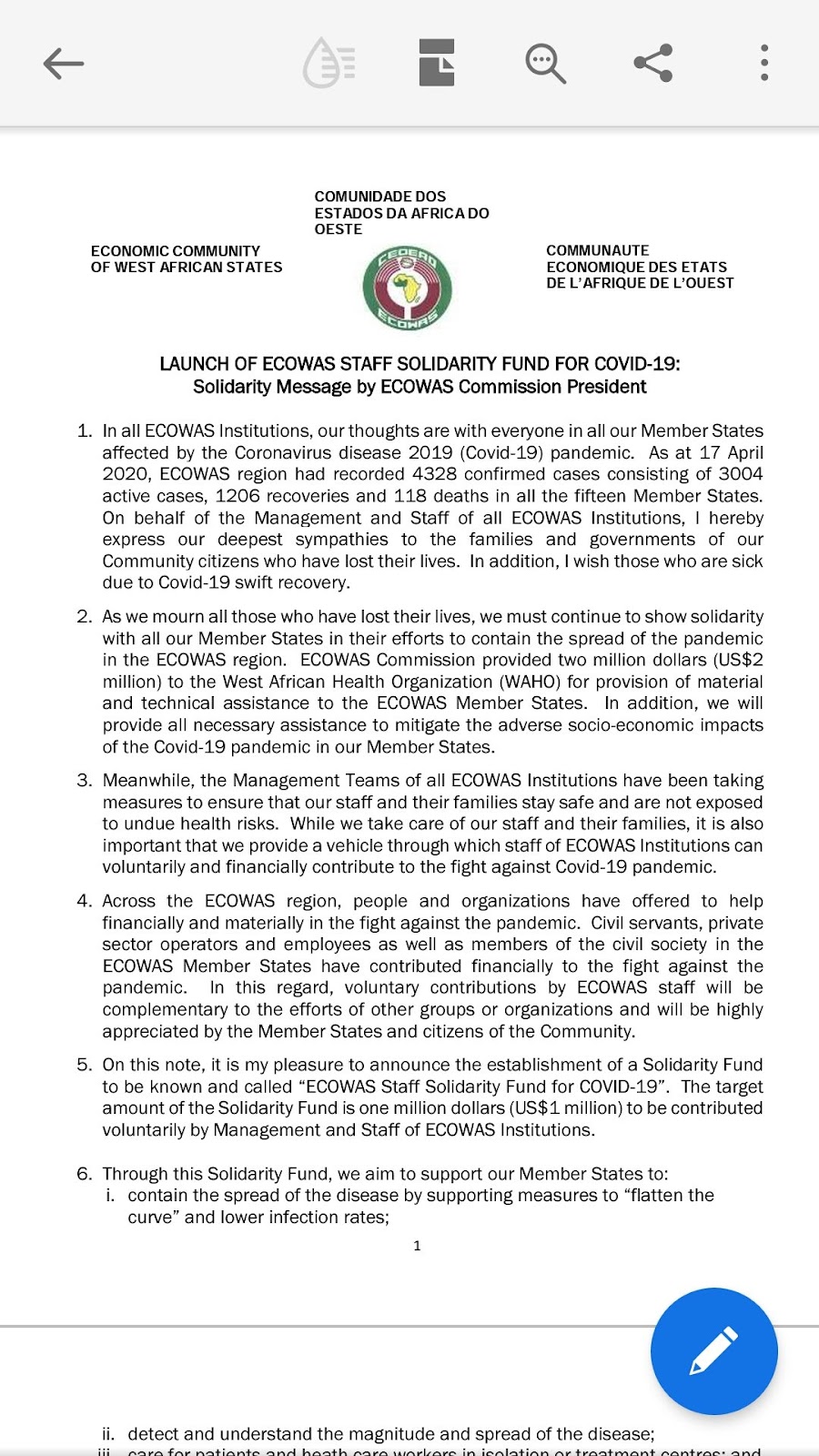
ECOWAS COMMISSION LAUNCHES STAFF SOLIDARITY FUND FOR COVID19


ECOWAS Commission, the executive arm of the ECOWAS institutions, has launched *ECOWAS Commission Staff Solidarity Fund for COVID19*, which target is *USD1 million as contributions from staff* across ECOWAS.


Here is a copy of the rationale of the Fund picked from the statement, which is available upon request at ecowasbusinessnews@gmail.com :


"Through this Solidarity Fund, we aim to support our Member States to: 


 i. *contain the spread of the disease* by supporting measures to "flatten the curve" and lower infection rates;


ii. detect and understand the *magnitude and spread of the disease* ; 


 iii. *care for patients and heath care workers* in isolation or treatment centres; and  


iv. *support organizations and people* whose livelihoods have been disrupted by the pandemic."


ENDs

Tuesday, 21 April 2020

Covid 19 has Africa at a Crossroads-Pan-Africanism or Capitalism


By: Mjiba Frehiwot

COVID pic-2020

Source: https://images.app.goo.gl/7omgrUMquSUSzhdd6

To eat and risk contracting COVID-19 or to be locked down and risk not eating.  This is the decision that many African people are facing at this very moment.  The devastating impact of COVID-19 on humanity is not in question here.  Nor is the issue that Africa cannot afford to be plagued with COVID-19 or death by starvation.

What is in question now at this very moment is what road will Africa and African people decide to take?  As we speak many countries are on a partial or full lockdown where everyone, but essential employees must stay inside their homes and not work and wait for the horror of the virus to pass by their small, medium or large nations.  However, public outcry and protests from Cape Town (South Africa) to Accra (Ghana) to Mangochi (Malawi) show that a lockdown like what is occurring in parts of Europe and the US is not as easy as it seems in most African countries.

In Ghana, the partial lockdown was lifted with the Social Distancing protocols still intact. In South Africa, the lockdown is still in place and in Malawi, the lockdown has been suspended by the high court.  Most nations on the continent are at different stages of the fight against both COVID-19 and hunger.  Before I go on let me be crystal clear that I am in no way criticizing any government for their handling of the crisis. I am however trying to ask critical questions about why Africa is facing a crisis of this magnitude as individual nation-states and not a unified continent.

Kwame Nkrumah and his contemporaries advocated for Pan-Africanism-a unified Africa politically, economically and socially.  63 years on and the Pan-African vision of Julius Nyerere, Sekou Toure, W.E.B. Du Bois, Shirley Graham Du Bois, Marcus Garvey, and many others feels farther away than ever.   Although there are regional and continental bodies that are independently and perhaps collectively trying (their best) to tackle COVID-19 it is not enough. It will not be enough because there is not a unified political and economic system that addresses Africans basic human needs (Health Care, Employment, Housing, Education, etc).  The lack of these basic human rights is only going to exacerbate the reach of COVID-19 on the continent (another point of clarity - these human rights are lacking because of capitalism and neo-colonialism).

Pan-Africanism is now needed more than ever before! What we need is a Pan-African response to COVID-19 and Capitalism.  For the absence of any confusion when I say Pan-Africanism I mean: The total Liberation and Unification of Africa under Scientific Socialism.  However, some may not be ready to accept Scientific Socialism as the economic system in Africa.  This is not a sticking point at this moment. What is a sticking point is that Africa and African nations must unify beyond the surface-level of agreements or unions.  Africa needs a unified response to COVID-19 and to capitalism (the primary reason for underdevelopment in Africa)!!!

This response must be executed at the individual, community, national and continental level!  Let me humbly suggest the following ways forward:

Individuals:

What roles are individuals playing in fighting COVID-19?  Are they sitting in their houses waiting on the pandemic to pass?  This is not good enough! Every individual must dedicate themselves to fighting for the integrity of their community, nation, and continent.

This can easily happen if we viewed ourselves as agents of development and defenders of Mother Africa. Africans regardless of class or class mobility have a role and responsibility to transform Africa. What is the role of the lecturer, market women, businesswoman or man, or politician, etc?  We must:


    1. Institute public/political education campaigns (organized collectively and in smaller communities) - we must transform our ideology to one that seeks direction to one that has its own agency.

    2. Create and donate funds to help support people who live from hand to mouth. This goes beyond going to buy at a shop and asking for a reduced price. We must sacrifice our own comforts to donate to a fund that will serve as a humanitarian bridge during this time.

Community:


    1. The community is a manifestation of the people and as such there may be some overlapping suggestions or individuals who find themselves in all these spaces.

    2. The community must be led by traditional leaders, religious leaders (some people will be angry with me saying this-but this is Africa), revolutionary organizations, environmental activists, scholars on the front lines, unions, etc.

    3. These leaders must lead a political education campaign that challenges the role of Pan-Africanism in fighting this pandemic. They must challenge capitalism as the fundamental contradictions.  These organizations must create spaces for the community to come together and make collective decisions about the way forward.

    4. They must not just use their leverage as leaders to exploit the masses for their own gain. They must use their roles to encourage the people to challenge the status quo; they must organize community fundraisers to support those who need support. They must step in to fill the gap between their class and that of the majority of Africans.

    5. The organization of small study groups to engage with both Pan-Africanism as a movement and concept. It will challenge the community to get involved in the Pan-Africanism, but also can serve as a vehicle for identifying community challenges.

Nation:

  1. African nations must first and foremost provide the following for their citizens:

    1. A weekly allowance to everyone in the country who lives hand to mouth.  This includes those people who are not citizens but came into the country to work or to flee their home countries.  This allowance should be based on the country and what is needed to live for 1 week.  This can easily be administered through mobile money.

    2. If it is not feasible to give a monthly allowance provide food rations every week.  Let's look to Cuba for this example.

    3. Immediately, provide compulsory health insurance to everyone in the country.  This is not the pay for play model but one that allows everyone to go to a health clinic without the fear of not having money to pay.

    4. Employ all nurses, doctors and medical professionals that are trained and not employed.

    5. Train community advocates and health education workers to go door to door in every community to hold education sessions about COVID-19. There are many University graduates who would (with the correct PPE) be excited to contribute to this fight.

    6. Develop employment programs for individuals who lost their businesses or who are chronically unemployed.  This can be an extension of national service campaigns but people especially Youth will need jobs. 

    7. Coordinate responses to COVID-19 across borders. Do not look inward; recognize that when your neighbour country is plagued with cases you may soon be plagued as well.

    8. Slowly reduce dependence on importing solutions-the virus has exposed that an over-dependence on importing anything from financial support to food can drastically cripple states.  

Continent:

  1. The Continental question is a much larger and more complex question to answer.  This is to say that we need a comprehensive dialogue around this question of continental unity and how to promote Pan-Africanism.

  2. The continent needs to play the long game when it comes to a response to COVID-19 and Capitalism.

  3. The African Union and other regional bodies need to promote the establishment of a universal and compulsory healthcare system across the continent.

  4. Look to Cuba and invest in free quality and Africanized higher education including medical schools to ensure that there are enough doctors throughout the continent to combat the onslaught of COVID-19 but also HIV/AIDS, Hypertension, Heart Disease, Asthma, and other non-communicable diseases.

  5. On a continental basis, there needs to be a serious discussion about the large "informal sector" of workers who have neither the ability to sustain their families for 1 week much less several months economically.  This population contributes to the economy in African countries, yet they are the least protected.  

  6. Promote African financial institutions that can address nations economic shortcomings. After all the fight against a lockdown or to lift a lockdown is an economic fight.

  7. Take the discussion about Pan-Africanism and continental unity to the base and encourage every African to get in the fight for Pan-Africanism.

I am not a politician; I am an activist and academic who may have lofty ideas about the way forward.  However, the suggestions above are not new and have been provided by Pan-Africanist that proceeded me in death and those who are my contemporaries.  At what point will we decide enough is enough?

Contact:

Email: mafrehiwot@gmail.com

Twitter: africaishome

Blog: https://panafricandevelopment.wordpress.com/ 


Friday, 27 December 2019

Why East Africa Rising?

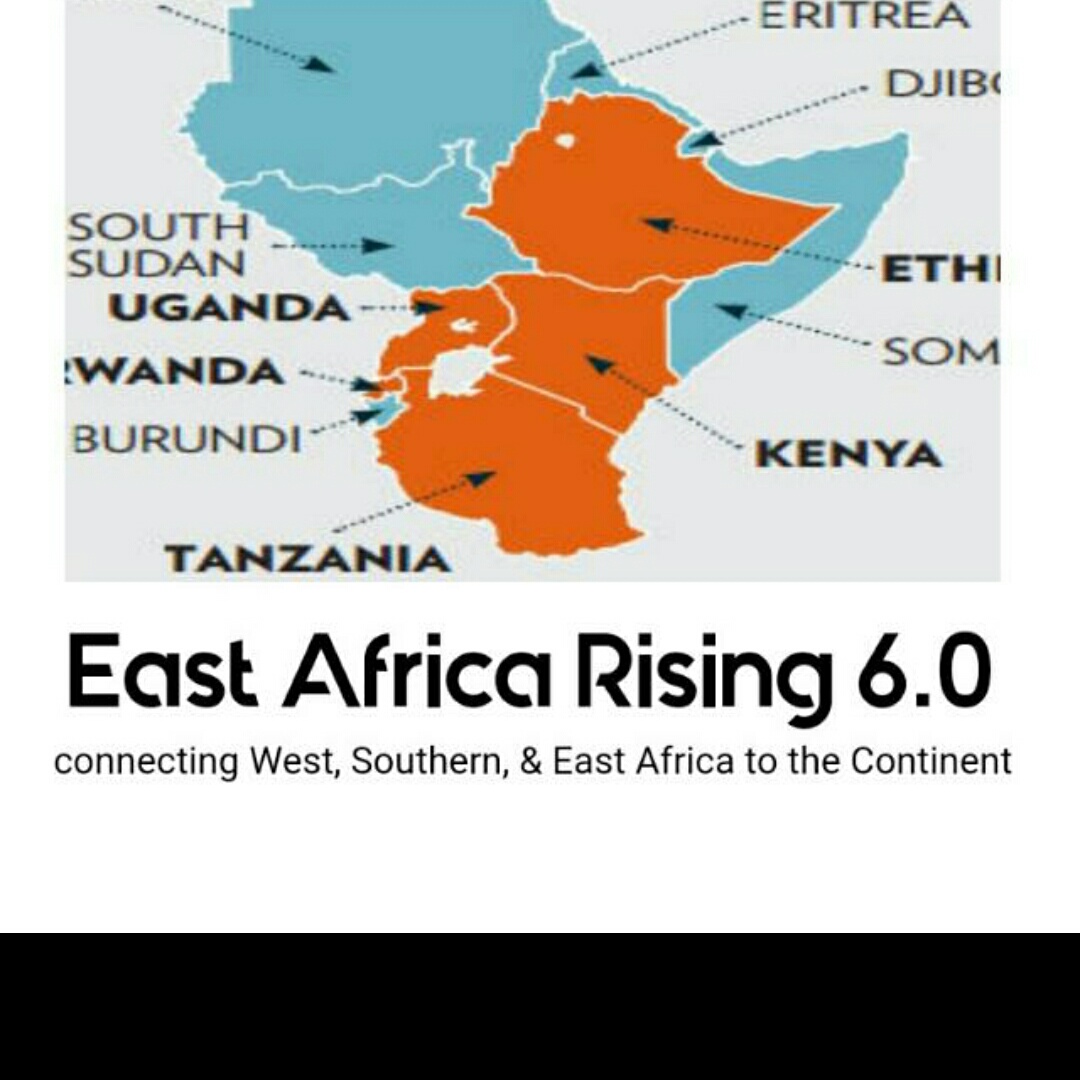
EAR is an initiative of the Africa in Focus (AIF) Research and Communications Unit (ReComm) that seeks to integrate East African perspectives, and best practices in conversations around West, and Southern African integration.


Using whatsapp largely as the flagship communicating tool, it serves as a catalyst for conversations on the African narrative. The group has expanded from merely East African countries in 2014 and 2015 to include strategic countries from the SADC region. In 2018 and 2019, EAR has enjoyed membership from SADC/COMESA countries, as well as those from Gambia and Liberia (in the West African Monetary Zone countries).


EAR is now in its *fourth iteration* (East Africa Rising 4.0) since it started in 2014. It now includes strategic SADC countries ( *Zambia; Zimbabwe; Botswana & Namibia*), all of which play critical roles in the Southern African region. The game-changer to transforming EAR 3.0 to EAR 4.0 was South Africa. Although membership includes diasporans living in South Africa, the inclusion of a consummate South African journalist/producer brings representation of the three hegemons of Kenya; Nigeria; and South Africa into this most unique of Pan-Africanist groups that has already spilled over from the virtual to offline, and will continue to do so as it moves to East Africa Rising 6.0 in 2020.


ENDs


📞CONTACT:
❄www.twitter.com/eastafricarisng

❄www.instagram.com/eastafricarising

❄www.facebook.com/eastafricarising